The IT department you don’t have to hire.
Patching, backups, monitoring, licensing, vendor calls and the person who picks up when the printer stops. One flat monthly fee, scope written into the contract, month-to-month.
Most small companies don’t have an IT problem. They have an ownership problem.
Someone’s nephew set up the server. The backup has been failing quietly since March. Licences renew on a card that expired. Nobody owns any of it — until it breaks, and then everybody does. Managed IT is the decision to give it one owner.
Everything an internal IT team would do.
Six areas, all in the base fee. No à la carte menu, no per-ticket billing, no surprise line items at quarter end.
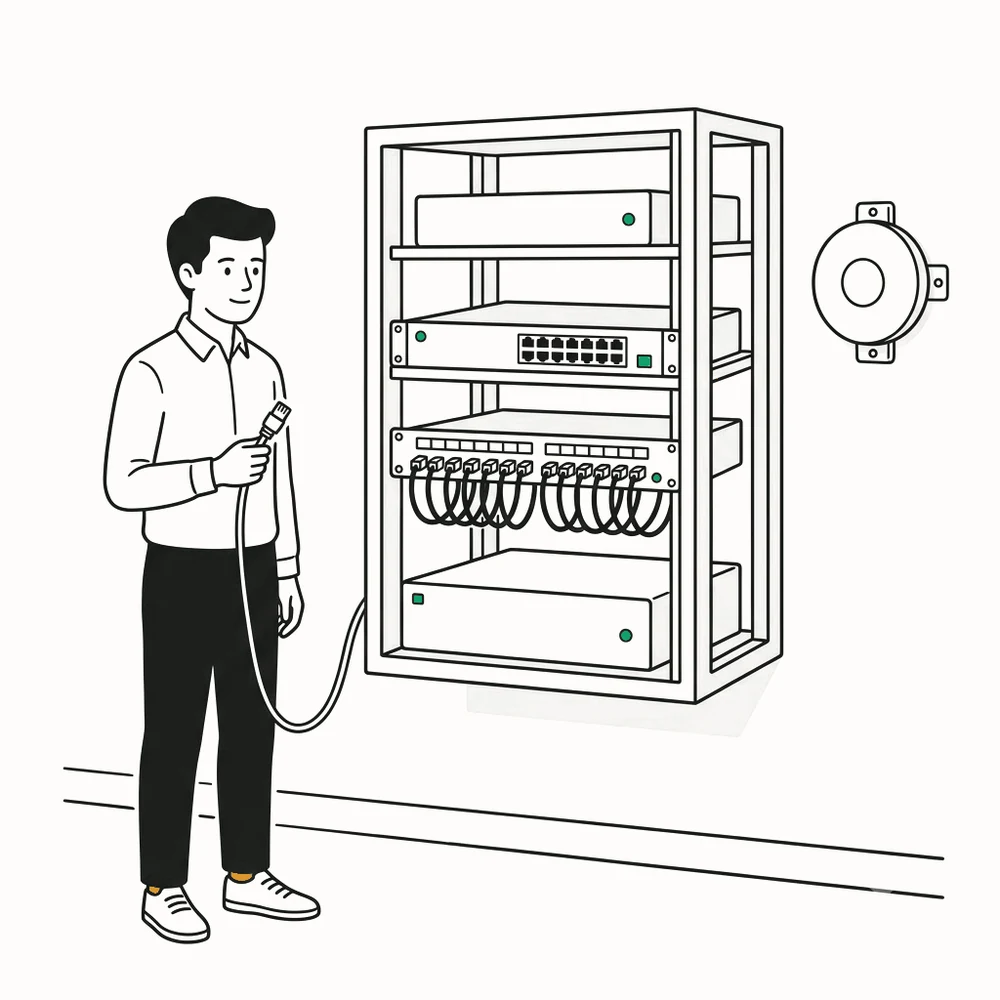
- Firewall
- The box between your office and the internet. It controls what gets in and out, and carries the VPN your staff use from home.
- Switch
- The hub everything plugs into. Every desk, printer, phone and access point reaches the network through this.
- Patch panel
- Where the cables buried in the walls terminate. It keeps the cabling orderly and lets a desk be re-pointed without pulling new cable.
- Server
- Shared files and the applications your business runs on, when they sit in your office rather than in the cloud.
- Wireless access point
- The Wi-Fi. Mounted away from the rack for coverage, and managed, patched and monitored with everything else.
Click a part to see what it does
Helpdesk & end-user support
Your staff phone or email an engineer directly — no portal maze, no offshore tier one reading a script. Unlimited within scope.
Monitoring & patching
Agents on every endpoint and server, watched around the clock. Patches tested and scheduled outside your working hours, not pushed blind on release day.
Backup & recoverability
Backups run nightly and get restore-tested quarterly, because an untested backup is a rumour. Deeper requirements are handled by Backup & Disaster Recovery.
Microsoft 365 & identity
Tenant administration, licence right-sizing, conditional access, MFA enforcement and mailbox hygiene. Most clients save more on unused licences than they expect.
A security baseline, not an upsell
EDR on every endpoint, mail filtering, DNS filtering and a managed firewall — all in the monthly fee, not held back for a higher tier. Adding Sophos MDR puts staffed 24/7 analysts behind that telemetry; it carries a real per-endpoint cost, so we quote it separately. The full picture is on Cybersecurity.
Vendors, documentation & planning
We hold the line with your ISP, your line-of-business software vendor and your phone provider. Everything is documented, and the documentation is yours — including on the way out.
Written down, not implied.
Priority is set by business impact, not by who shouted loudest. The times below are what we aim for and measure ourselves against — they are targets, not a guarantee, and we would rather publish the real ones than a number designed to look good on a page.
| Priority | Example | Respond | Resolve |
|---|---|---|---|
| P1 · Down | Server offline · site-wide outage · suspected breach | Respond15–30 min | Resolve2–4 hours |
| P2 · Degraded | One team blocked · mail flow delayed · shared drive slow | Respond1 hour | Resolve4–8 hours |
| P3 · Single user | One person can’t print · password reset · app error | Respond2–4 hours | ResolveNext business day |
| P4 · Scheduled | New starter setup · hardware order · planned change | Respond4–8 business hrs | Resolve1–3 business days |
What’s in, and what isn’t.
Every MSP has a boundary. Most bury theirs in an appendix. Here it is on the sales page, because arguing about scope in month four is how these relationships die.
- Unlimited remote and phone support within business hours
- All monitoring, patching and backup administration
- EDR, mail and DNS filtering — licensing and management
- M365 tenant administration and user lifecycle
- Vendor coordination on your behalf
- Documentation, asset register and quarterly review
- Hardware, software and licence costs at cost
- Office moves, cabling and new-site builds
- Major migrations and infrastructure projects
- Custom development and web work
- After-hours coverage, if you want it standing
- Sophos MDR, if you want staffed 24/7 cover
If something falls outside scope, you hear the number before we start — never on the invoice.
Handover is the part most providers get wrong.
The same sequence, written out week by week: what actually happens in the first thirty days of a managed IT engagement. Before you sign with anyone, the twelve questions worth asking any Ottawa MSP are worth ten minutes. Who you would actually be working with is on the about page. For a smaller office, the same plan is laid out at that size on small business IT support.
What runs, and how often.
From day 30 onward, managed IT is a set of recurring obligations rather than a retainer you hope gets used. This is the schedule your environment runs on — and the evidence each obligation produces.
| Cadence | What runs | What you receive |
|---|---|---|
| Continuous | RunsEndpoint and server monitoring, EDR telemetry, plus Sophos MDR analyst coverage where subscribed | You getContact only when something needs a decision |
| Nightly | RunsBackup jobs across servers, endpoints and Microsoft 365 | You getAny failure raised the same morning, not at month end |
| Weekly | RunsPatch review and approval; third-party updates staged for the maintenance window | You getPatch compliance figure per device |
| Monthly | RunsSecurity review — MFA gaps, dormant accounts, admin role creep, licence drift | You getException list, each item with an owner and a date |
| Quarterly | RunsRestore test from live backup; documentation refresh; business review | You getRestore evidence and a written review in plain English |
| Annually | RunsHardware lifecycle assessment, warranty and licence renewals, procurement planning | You getRefresh plan with dates and costs, a budget year ahead |
Every environment we run carries the same seven artefacts, kept current — not written once at onboarding and left to rot. All of it is yours, including on the way out.
- Asset register — every device, age, warranty, assigned user
- Network diagram, kept current with changes
- Credentials in a vault you also hold keys to
- Licence and subscription inventory with renewal dates
- Vendor list with account numbers and support paths
- Runbooks for the things specific to your business
- Written restore procedure, tested quarterly
We quote on scope, not a sticker price.
Per-user or per-device, monthly. The honest number depends on headcount, servers, licensing and after-hours expectations — twenty minutes on a call gets you a real one, not a range.
Below five people, a good part-time contractor is often the honest answer — and we’ll say so.
The ones people actually ask.
If yours isn’t here, ask it directly — you’ll get an answer from an engineer, not a form letter.
No. We run the documentation phase alongside whoever holds the keys today, then take over on an agreed date. Overlap is normal and we handle the conversation if it is awkward.
Anything on the covered list, for the users and devices in the agreement, during business hours. Projects, migrations and hardware are quoted separately — and always before the work starts, never on the invoice.
Usually. We inventory everything in week one and tell you what is fine, what is out of support and what is quietly costing you money. Nothing gets replaced because it suits us.
Thirty days’ notice, and your documentation, credentials and asset register are handed over in full. No exit fee, no hostage-taking. It is in the contract because you should not have to ask.
Yes. macOS, Windows, iOS and Android are all managed through Intune where it makes sense. Mixed fleets are the norm, not an exception we charge extra for.
Automated security monitoring runs 24/7 by default; staffed Sophos MDR response is an optional add-on, quoted separately. Standing after-hours helpdesk coverage is also an add-on — most clients start without it and add it once they can point at a reason.
Around five people is the honest floor. Below that, a good part-time contractor usually serves you better, and we will tell you so on the call rather than sell you something you do not need.
Ottawa. The person who answers your call is the person who built your environment. There is no offshore tier one and no ticket routing queue.
Next
// What happens after you book
No sales sequence, no discovery deck, no second call to meet the closer. Three steps, and you own everything we write.
A short intake
Five questions by email — headcount, what you run, what breaks most. It means the call starts at the useful part.
Twenty minutes
You talk, we ask. No slides, no product tour. If it needs longer we book longer, but it rarely does.
A written scope
Within three business days: scope, a fixed monthly number, and the 30-day onboarding plan. Yours to keep either way.
If managed IT isn’t what you need, we’ll say so on the call and point you somewhere better. That happens often enough to be worth putting in writing.
On-site across the National Capital Region — Ottawa, Kanata, Nepean, Barrhaven, Orléans, Stittsville, Manotick and Gatineau. Remote support covers anywhere in Canada. The registered office is on Thurston Drive; we answer Monday to Friday, 08:00–18:00 ET.
If we’re doing our job, you forget we exist.
Twenty-minute call. No deck, no pressure. We listen, then propose — and tell you the parts you don’t need.